BLOG
Autonomous Harvesting Technologies: When Do Robots Really Work in Agriculture?
Why Is Autonomous Harvesting Difficult in Agriculture?
In the agricultural sector, labor costs are rising while finding skilled workers becomes increasingly difficult. This landscape makes autonomous harvesting technologies attractive. However, many robotic harvesting attempts fail when taken outside controlled environments. The fundamental reason is the variable and unpredictable nature of agriculture.
Lighting conditions, product positions, leaf density, and environmental factors create a much more complex perception problem compared to industrial production lines.
The Real Critical Factor in Robotic Harvesting: Perception
In autonomous harvesting systems, it is not the robot's "arm" but its "eye" that is decisive. Simply seeing the location of a fruit or vegetable is not enough; ripeness level, damage status, and the correct grasping point must also be detected. This requires 3D vision and AI-powered analysis beyond conventional sensor approaches.
Incorrect detection leads not only to yield loss but also to product damage and reduced system reliability.
When Does It Really Work?
Autonomous harvesting systems become operational in the field only when perception, decision-making, and robotic motion are designed together. It is critically important that algorithms are trained under real field conditions, can adapt to different product types, and respond quickly to changing environmental conditions.
In successful applications, the system operates not merely as a robot, but as a decision mechanism adapted to the field.
Field-Ready Autonomous Harvesting with MIS-AGRO
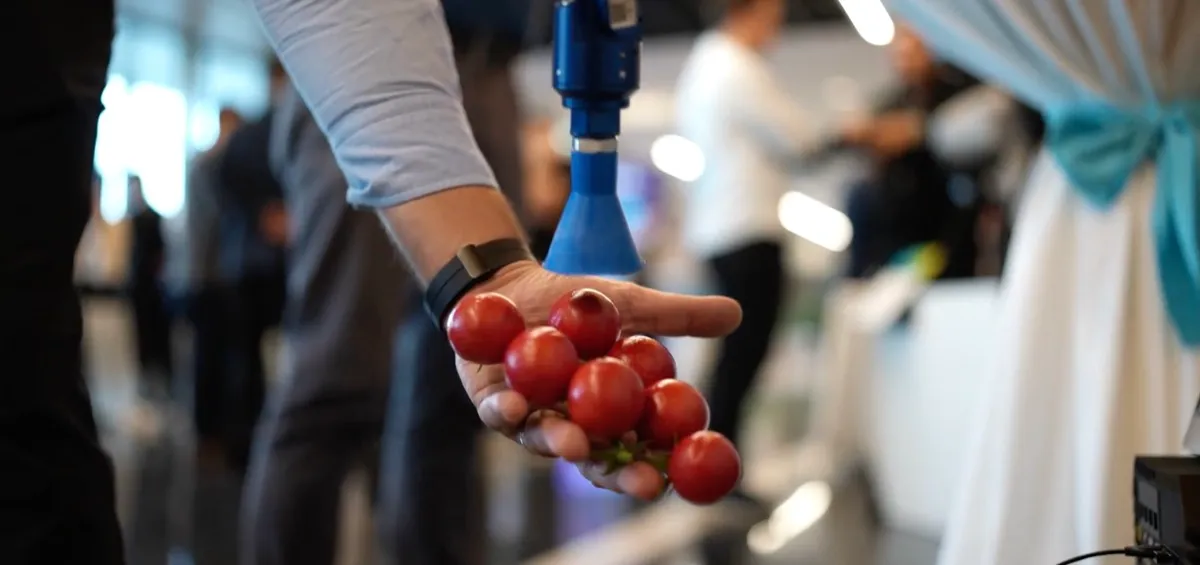
MIS-AGRO combines 3D machine vision, AI-powered perception, and robotic systems under a single solution architecture. Beyond detecting the location of fruits and vegetables, the system analyzes ripeness levels to make the correct harvesting decision.
The goal is not to fit the robot to the agricultural environment, but to develop an autonomous system that adapts to the real conditions of agriculture. Thanks to this approach, autonomous harvesting transforms from a concept stage into a technology that operates reliably in the field.