BLOG
What Are AMRs? Autonomous Mobile Robots and the New Era of In-Plant Logistics
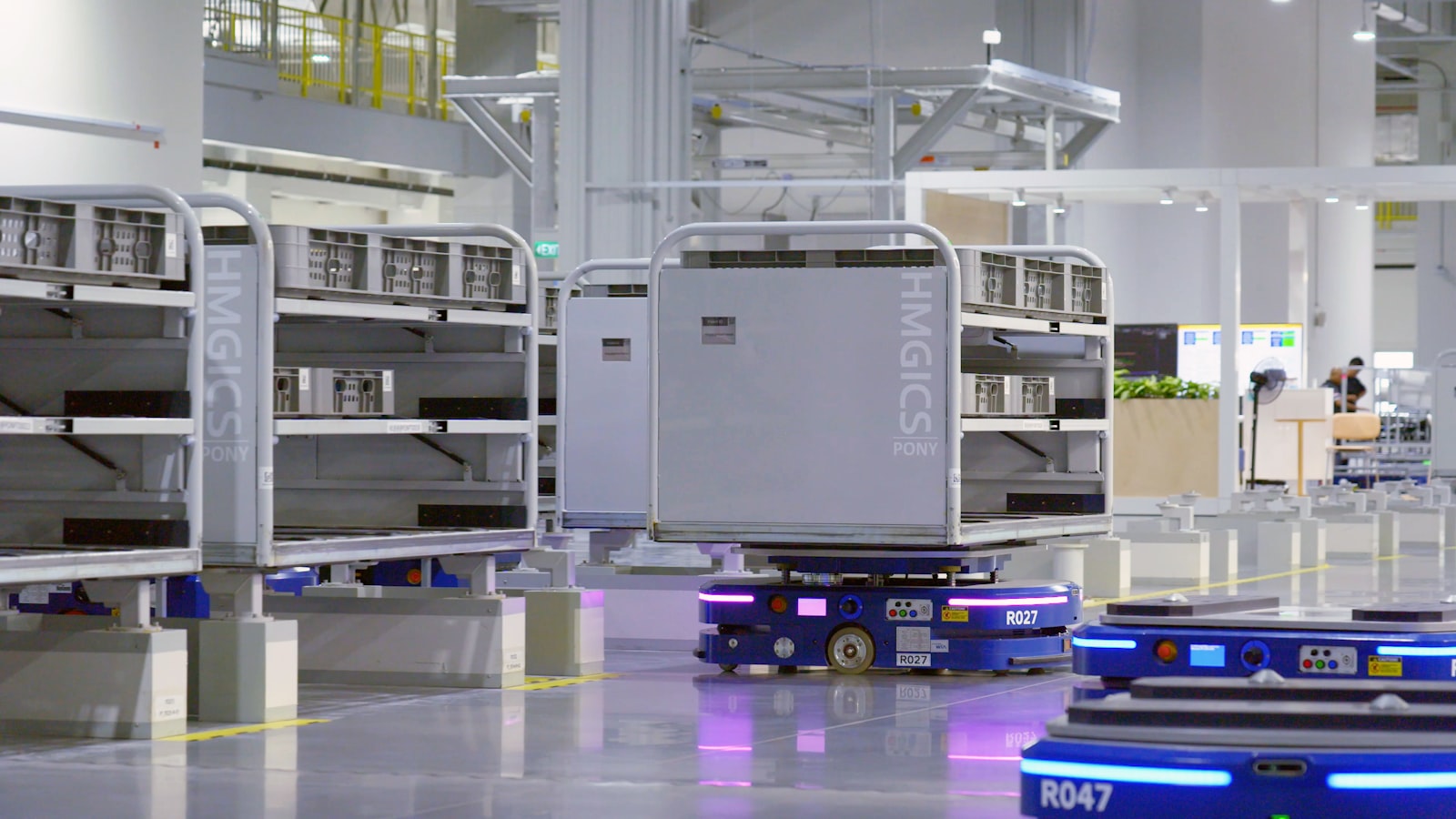
AMR (Autonomous Mobile Robot) is a transport robot that navigates factories and warehouses without pre-defined paths. Using SLAM (Simultaneous Localization and Mapping) and sensor fusion, the AMR perceives its surroundings in real time and finds its own way. Unlike traditional AGVs (Automated Guided Vehicles), no floor tape or magnetic strips are needed — the AMR maps the environment, avoids obstacles and generates new routes on its own.
AMRs are the fastest-growing segment in industrial logistics, with the market projected to grow above 19% annually through 2030. In this article we cover the technical differences between AMRs and AGVs, typical field applications, ROI calculations, and the integration architecture with robotic bin picking.
What is an Autonomous Mobile Robot (AMR)?
An AMR is a mobile platform built on three core capabilities:
- Localization: By fusing LiDAR, camera and IMU data, the robot knows its own position to centimeter accuracy.
- Mapping: As it moves through the environment, the robot builds a 2D/3D map and continuously updates it as conditions change.
- Path planning: Algorithms like A* or RRT* compute the optimal route on the fly and recompute when obstacles appear.
The result: a flexible transport solution that can operate in the same aisles as humans and is reconfigured purely in software.
AGV vs. AMR: The Differences That Matter
Decision-makers often confuse AGVs and AMRs. Side-by-side:
- Navigation: AGVs follow magnetic tape, paint or QR codes on a fixed path; AMRs roam freely using sensors.
- Obstacle behavior: AGVs stop when they see an obstacle; AMRs route around it.
- Floor flexibility: When a production layout changes, AGV infrastructure must be re-laid; AMRs adapt with a software update.
- Initial cost: AGVs are cheaper upfront but infrastructure and conversion add up; AMRs are more expensive per unit but require minimal infrastructure.
- Scalability: AGV fleet management is limited; AMRs coordinate fleets of 100+ robots through cloud-based orchestration.
Typical AMR Use Cases
The most common scenarios in the field:
- Raw material feeding: Automated container transport from warehouse to production line.
- WIP transfer: Automating Work in Process movement between stations.
- Finished goods pickup: Carrying packaged products from line end to dispatch.
- Goods-to-person picking: Bringing the product shelf to the human in the warehouse — 3-4x throughput gain.
- Returns and recycling flow: Collecting empty pallets and waste back from the floor.
AMR ROI: When Does It Pay Back?
Typical AMR payback periods land between 12 and 24 months. Factors that drive the math:
- Savings on manual transport operator cost (3 shifts × annual)
- Reduced workplace injury and fatigue cost
- Continuous production flow (forklift wait time goes to zero)
- Inventory accuracy (every move is logged)
- Flexibility premium: no infrastructure rework when layouts change
AMR + Bin Picking: A Fully Automated Logistics Flow
AMRs are powerful on their own, but the real transformation comes when integrated with robotic bin picking. The flow:
- The AMR brings a product container from the warehouse to the picking station.
- The MIS-PICK robot arm uses 3D vision to grasp mixed parts from the container.
- It places the parts in order onto a pallet or shipping case.
- When done, the AMR collects the empty container and ferries the full one to dispatch.
In this flow, human intervention is reserved for exceptions; the rest runs autonomously 24/7.
What to Watch When Choosing an AMR
Critical evaluation points for AMR investment:
- Payload capacity: Common ranges run 100-1,500 kg. Heavy loads need specialized platforms.
- Safety certifications: ISO 3691-4 and EN 1525 are mandatory for industrial safety.
- Fleet orchestration: Vendor's multi-robot management capabilities (traffic control, task assignment).
- WMS/MES integration: Must integrate with the warehouse management system.
- Battery and charging strategy: Autonomous opportunity charging or battery swap? Affects operational continuity.
Conclusion
AMRs make in-plant logistics flexible, scalable and data-driven. They are one of the core actors of human-robot collaboration in the Industry 5.0 vision. MIS Automation is happy to share field experience on AMR + robotic bin picking integration — to discuss an architecture for your project, get in touch.