BLOG
Robotic Automation Systems: How to Build a Robot Cell in Your Factory
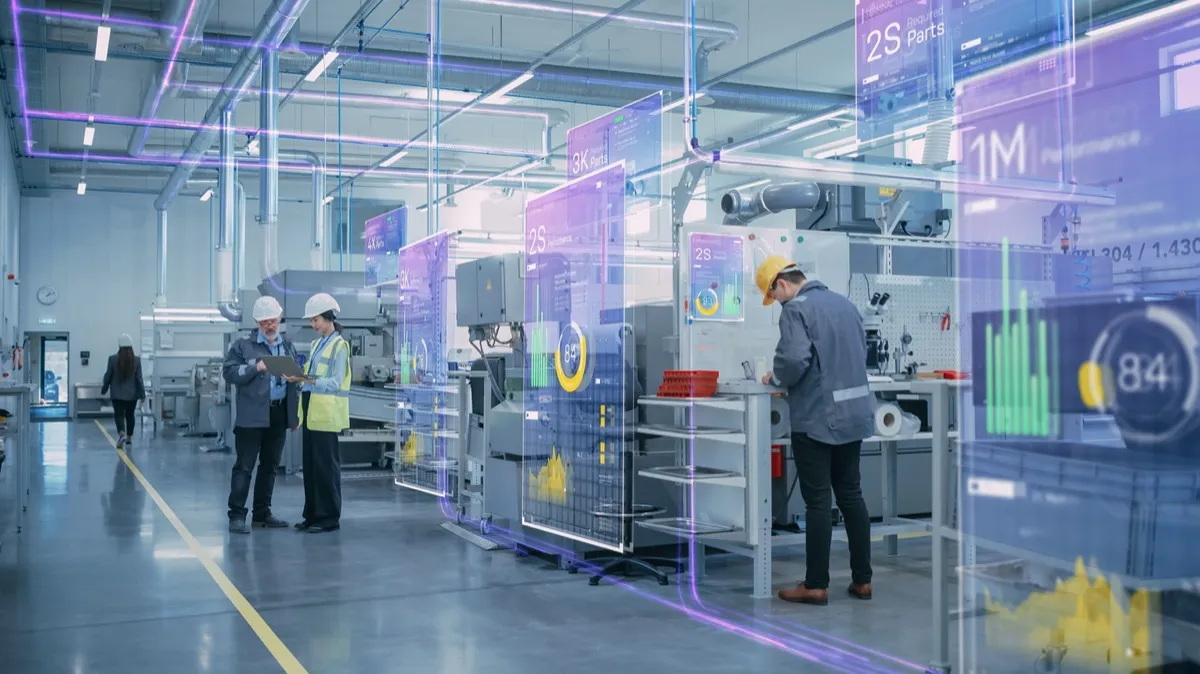
In many factories the decision to "get a robot" is discussed as if it meant buying a robot arm. A robotic automation system that actually works on the shop floor, however, consists of a vision system that sees the part, a gripper that holds it, software that plans the motion, feeding that brings the part into the cell and safety equipment that protects people. The robot is only one part of that system. In this article we explain where robotic automation sits within factory automation, what a robot cell is made of, which tasks suit robots and what to look for when evaluating companies that build robotic automation systems.
Factory Automation vs. Robotic Automation
Factory automation is a broad term: PLC-controlled machines, conveyors, sensors and monitoring software such as SCADA and MES all fall under it. Most of these systems are designed to repeat one fixed task at high speed and need mechanical adjustment when the product changes.
Robotic automation is the flexible layer of factory automation. Because the robot is driven by a program, the same cell can work with different parts, different stacking patterns or different tasks. The source of that flexibility is usually not the robot itself but the vision system and software that guide it.
What Is a Robot Cell Made Of?
| Component | Role | What drives the choice |
|---|---|---|
| Robot | Performs the motion: industrial robot arm or cobot | Payload, reach, cycle time, whether it shares space with people |
| Vision system | Detects the part's position, orientation or defects | Whether parts arrive ordered or random, whether 2D or 3D is needed |
| Gripper or robot hand | Grasps and releases the part | Part weight, surface, fragility and number of variants |
| Software | Turns vision data into robot motion, plans the path, handles errors | Who programs it, how much work a product change requires |
| Feeding and discharge | How parts enter and leave the cell: conveyor, pallet, bin | Fit with the existing line and forklift flow |
| Safety | Fencing, door interlocks, area scanners, emergency stop | Risk assessment and operator access to the cell |
Projects rarely stall on the choice of robot; they stall on the lower rows of that table. If parts arrive unordered, the vision system carries the real engineering load; if parts vary, the gripper does; if products change often, the software does. We cover the gripper side in detail in our gripper vs. robot hand comparison.
Which Tasks Suit Robotic Automation?
Tasks that are repetitive, measurable and heavy or risky for people are natural candidates. These are the applications we see most often on the shop floor:
- Palletizing and depalletizing: stacking cartons and sacks onto pallets or unloading them (robotic palletizing).
- Machine tending: loading and unloading CNC machines and presses (machine tending automation).
- Bin picking: picking randomly placed parts one by one with 3D vision (3D bin picking).
- Welding: seams that require repeatable quality (robotic welding systems).
- Pick and place and packing: taking products from a line and placing them in a box, tray or on another line.
- Visual quality inspection: stations where a camera detects the defect and a robot removes the faulty part (choosing a quality inspection camera).
We describe five criteria for choosing your first application in Where Should the First Robot Go in a Factory?
Fixed Cell or Vision-Guided Flexible Cell?
If the part always arrives in the same place and orientation, the robot can move between taught points. That is the simplest and cheapest setup. In many factories reality looks different: parts are dumped into bins, cartons arrive in different sizes and the product family changes from week to week.
In that case you either add fixtures and mechanical feeders to order the parts, or you give the robot vision. In a vision-guided cell the camera measures the part's position in every cycle and the robot plans its motion accordingly. Mechanical ordering gets more expensive as the number of products grows; in a vision-guided cell a new product is often defined in software. We compare when 2D and when 3D vision is needed in a separate article.
Where Does the Cost of Robot Automation Systems Go?
The most common mistake when comparing quotes is looking only at the robot price. Total cost includes the gripper, fixtures, vision system, safety equipment, feeding mechanics, software and commissioning, and in many projects these items together exceed the price of the robot. You will find the breakdown in Where Is the Real Cost in Robotic Automation?
When calculating payback, labour hours saved are not the whole story either. The number of shifts, lower scrap, workplace safety and the difficulty of staffing hard jobs often change the result.
How to Evaluate Robotic Automation Companies
A few basic questions help when choosing between robotic automation companies:
- Have they run a similar application in the field before?
- Do they offer a test (PoC) with your real parts and a written success criterion?
- Are they tied to one robot or camera brand, or do they choose hardware for the application?
- Who will own the software, and who will step in when the product changes?
- How will service and spare parts be provided after commissioning?
We go through each of these criteria with examples in How to Choose an Automation Company.
How MIS Automation Works
At MIS Automation we specialise in the machine vision and AI side of robotic automation projects. We choose the robot and camera brand to fit the application and work with brands such as FANUC, ABB, KUKA and Yaskawa. Our projects start with a pilot using real parts.
- MIS-PICK: robotic picking, placing and sorting with 3D vision and AI. ±0.2 mm accuracy and drag-and-drop setup without robot programming.
- MIS-INSPECT: deep-learning-based visual defect detection, integrated with PLC, SCADA and MES.
- MIS-TOUCH: a tactile robot hand with 508 pressure sensors that grips fragile and varying parts precisely.
Next Step
If you think there is a task in your factory that suits robotic automation, share your part and target cycle time and we will assess feasibility together. Start a project conversation.